
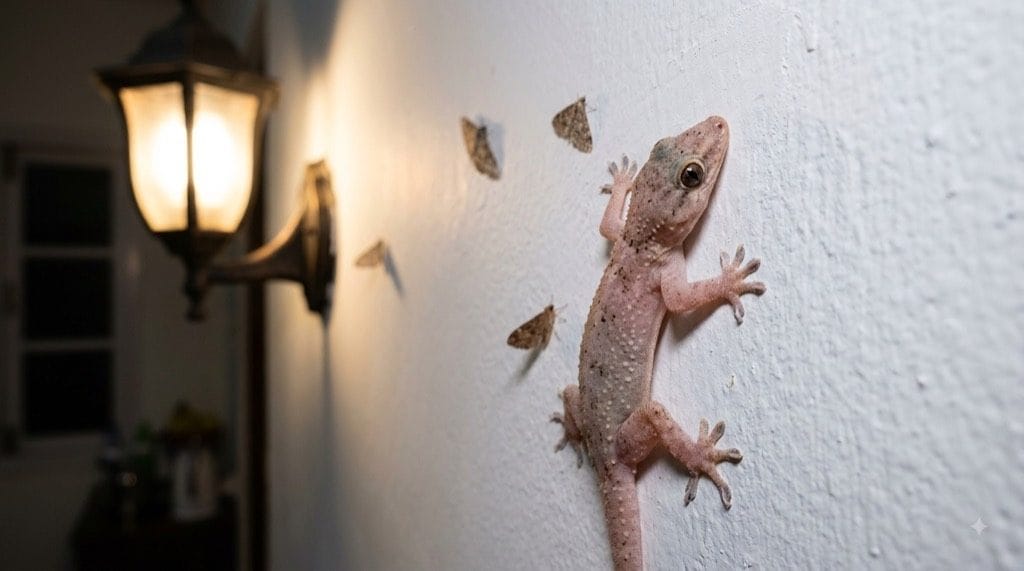
Asian house geckos are small, introduced lizards that are now one of the most common geckos in Australia — harmless to people, but a sign there are enough insects in and around your home to keep them fed. You’ll usually see them on walls and ceilings at night, near lights where insects gather. They don’t really bite, aren’t venomous and won’t damage your home. But if you’re seeing them often, it’s worth looking at what’s drawing them in. Our residential pest control team can help you tackle the real issue — the insects. Here’s everything you need to know.
What Is the Asian House Gecko?
The Asian house gecko (Hemidactylus frenatus) is a small, pale-grey to pinkish-brown lizard about 7.5–15 cm long, with large eyes, sticky toe pads and a distinctive chirping call. Native to South and South-East Asia, it hitchhiked to Australia in cargo and is now firmly established along the east coast, including right across Sydney. It is considered an introduced, invasive species because it competes with native geckos for food and shelter.
Asian House Gecko vs Native Australian Geckos
Australia is home to more than 100 native gecko species, so not every gecko on your wall is the introduced one. Here’s how the Asian house gecko compares with our natives:
| Feature | Asian house gecko | Native Australian geckos |
|---|---|---|
| Origin | Introduced (South-East Asia) | Native to Australia |
| Size | 7.5–15 cm | Varies; many 5–20 cm |
| Call | Loud, repeated “chuck-chuck-chuck” chirp | Usually silent or soft |
| Where seen | On walls and ceilings, around lights, inside homes | Gardens, bushland, tree bark, rockeries |
| Status | Invasive; pressures native species | Protected native wildlife |
Types of geckos in Australia
Common natives include the thick-tailed (barking) gecko, the dtella, leaf-tailed geckos and marbled geckos. Most natives keep to gardens and bushland, while the introduced house gecko is the one you’ll typically find indoors near lighting.
Key identifying features
The Asian house gecko has a slightly warty back, obvious toe pads and often faint bands on the tail. It’s most active after dark and gathers wherever insects are drawn to light.
The chirping call
That sharp, repeated chirping at night is the giveaway — native geckos are generally quiet, so a chattering gecko indoors is almost always the introduced species.
Are Asian House Geckos a Pest? Are They Dangerous?
No — Asian house geckos are harmless to people. They are not venomous, they don’t transmit disease to humans and they rarely bite (and can’t hurt you if they do). The main downsides are small droppings left on walls and surfaces, and their impact as an introduced species that competes with native geckos. They’re best seen as a sign of an insect problem rather than a danger in themselves.
What Do Geckos Eat — and Why They’re in Your Home
Geckos are insect-eaters, and they turn up wherever there’s a reliable food supply. What do geckos eat? Mostly the household insects you’d rather not have:
- Mosquitoes
- Cockroaches and their young
- Moths and other night-flying insects
- Spiders
- Ants and small beetles
In other words, a gecko in your home means there are enough cockroaches, mosquitoes and moths to feed it. Deal with the insects and the geckos usually move on.
How to Get Rid of Geckos in Australia Naturally
Because geckos are protected in some contexts and are largely beneficial, the goal is to make your home less attractive rather than to harm them. Here’s how to get rid of geckos the natural way:
- Reduce the insects they feed on (the single biggest factor).
- Switch outdoor lights to warm/yellow “bug” globes, or turn them off when not needed, so fewer insects gather.
- Seal gaps around windows, doors, vents and eaves to block entry.
- Keep fly screens in good repair.
- Clear clutter, leaf litter and dense plantings against the house where insects and geckos shelter.
The Real Fix: Control the Insects Geckos Feed On
Geckos are a symptom, not the cause. The lasting fix is to bring the insect population down — once the food source dries up, geckos naturally look elsewhere. A professional treatment targets the mosquitoes, cockroaches, moths and spiders around your home and sets up a barrier that keeps them from coming back, which in turn reduces gecko activity without harming native wildlife.
When to Call a Pest Controller
Call a professional when you’re seeing lots of geckos, persistent droppings, or the insects that attract them — cockroaches inside, clouds of mosquitoes at dusk, or moths swarming your lights. Our team can identify what’s drawing them in and treat it safely around your family and pets. Learn more about our residential pest control services across Sydney.
Frequently Asked Questions
Are Asian house geckos dangerous?
No. They are not venomous, don’t transmit disease to people and rarely bite. The main issues are droppings on surfaces and their impact on native geckos as an introduced species.
How do I get rid of geckos in the house?
Reduce the insects they eat, switch to insect-friendly outdoor lighting, seal gaps around doors and windows, and keep fly screens intact. Controlling the insects is what makes them move on.
Why do I have geckos in my home?
Because there’s food. Geckos follow insects — mosquitoes, cockroaches, moths and spiders — especially around lights at night. A gecko indoors usually means an insect problem nearby.
Do geckos bite?
Very rarely, and their bite is harmless — they have tiny teeth and aren’t aggressive toward people. They’re far more interested in insects than in you.
Sources: Australian Museum — Reptiles; CSIRO (invasive species).