

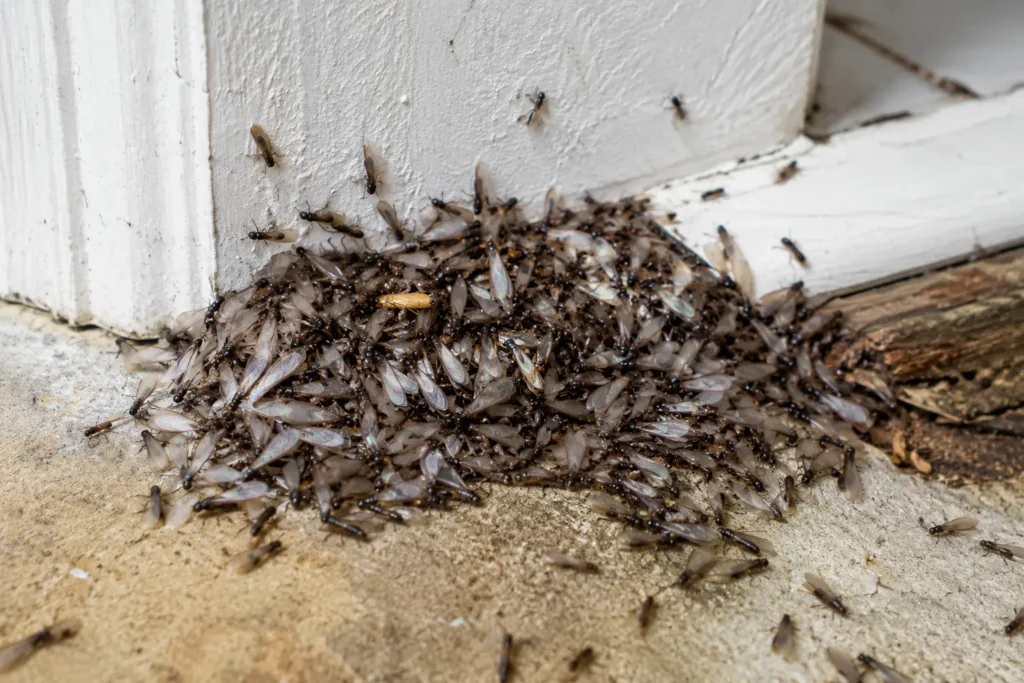
You step outside on a warm Sydney evening and see a cloud of winged insects pouring out of the ground near your garden bed, rising from a crack in the wall, or swarming around an outdoor light. Your first instinct might be to assume they’re flying ants — and hope they go away on their own.
But if those insects are flying termites, walking away is not the right move. A termite swarm does not mean termites are actively eating your home right this moment. It does mean there is a mature termite colony somewhere nearby — possibly already inside your structure — and that colony is large enough to start producing reproductive swarmers. That is a serious warning sign that demands immediate action.
This guide explains exactly what a termite swarm means, how to tell flying termites from flying ants, what to do in the hours and days that follow, and how to protect your home from the colonies that follow. If you’ve already seen a swarm, book a termite inspection today — don’t wait.
What Is a Termite Swarm?
What Are Termite Swarmers (Alates)?
Termite swarmers — also called alates or winged termites — are the reproductive caste of a termite colony. Unlike worker and soldier termites, which are blind and spend their entire lives inside tunnels, alates develop wings for a single purpose: to leave the parent colony, mate, shed their wings, and attempt to establish a new colony.
They are not the termites that eat your home. Worker termites do the structural damage. Alates are simply the colony’s way of reproducing. However, seeing them is direct evidence that a parent colony is mature, large, and close by — and that parent colony is almost certainly still active.
Why Do Termites Swarm?
A colony produces swarmers only when it has reached sufficient size — typically after three to five years of growth. Swarming is triggered by specific environmental conditions: rising temperature, humidity, and often rainfall. The entire colony releases hundreds to thousands of alates simultaneously in a coordinated event designed to maximise the chance of successful mating before predators can pick them off.
Most swarmers die within hours — they are poor fliers, vulnerable to dehydration, and heavily preyed upon by birds and insects. Of those that land and mate, only a small percentage successfully establish a new colony. But the ones that do can become the next structural threat to a home within a few years.
How Long Does a Termite Swarm Last?
The swarm event itself is brief — typically 30 to 60 minutes, rarely longer than a few hours. What you notice afterwards is more persistent: piles of discarded wings on windowsills, along door frames, and near light sources. Discarded termite wings are often the first physical sign homeowners find the morning after a swarm — and they are just as significant as seeing the swarm itself. If you find small, equal-sized wings in a pile near a window or door frame, treat it as confirmation of a swarm.
When Do Termites Swarm in Australia?
Termite Swarming Season in Sydney
In Sydney and the greater NSW coastal region, termite swarming activity peaks in spring and early summer — typically between October and January — when temperatures rise above 28°C and humidity is high. A second, smaller swarming period can occur in late summer (February–March) following significant rainfall. Swarming most often occurs in the late afternoon or early evening, shortly after rain.
Why Do Flying Termites Suddenly Appear?
The sudden appearance of flying termites is not random. It is a synchronised colony event, often triggered within hours of a drop in barometric pressure and a rise in humidity — the conditions associated with incoming rain. Multiple colonies in an area may swarm simultaneously in response to the same weather trigger, which is why a single evening can produce large numbers across an entire neighbourhood.
The appearance feels sudden because the swarm is concentrated into a narrow window. The colony has been building toward this event for months — you simply haven’t seen it until now.
Flying Termites After Rain: Why It Happens
Rain softens the soil and raises moisture levels, which makes it easier for newly mated pairs — the future queen and king — to excavate a founding chamber in the ground. Flying termites after rain is one of the most commonly searched queries in Australian pest control, and with good reason: the combination of warm, humid conditions following rain is the most reliable trigger for mass swarming events in Sydney’s climate.
Flying Termites vs Flying Ants: How to Tell Them Apart
This is the question most Sydney homeowners ask first — and getting it right matters, because the response is very different. Here are the key differences:
Flying Termite vs Flying Ant: Identification Guide
Feature | Flying Termite (Alate) | Flying Ant |
Waist | Broad, no pinch — uniform body | Narrow, pinched waist |
Wings | 4 wings, equal length | 4 wings, front pair longer |
Antennae | Straight, beaded | Elbowed / bent |
Colour | Pale brown to dark brown | Black, red or brown |
Body shape | Cigar-shaped, uniform | Segmented, distinct head/thorax/abdomen |
Wing shed | Wings drop off shortly after landing | Wings remain attached |
Key Differences: Body Shape, Wings and Antennae
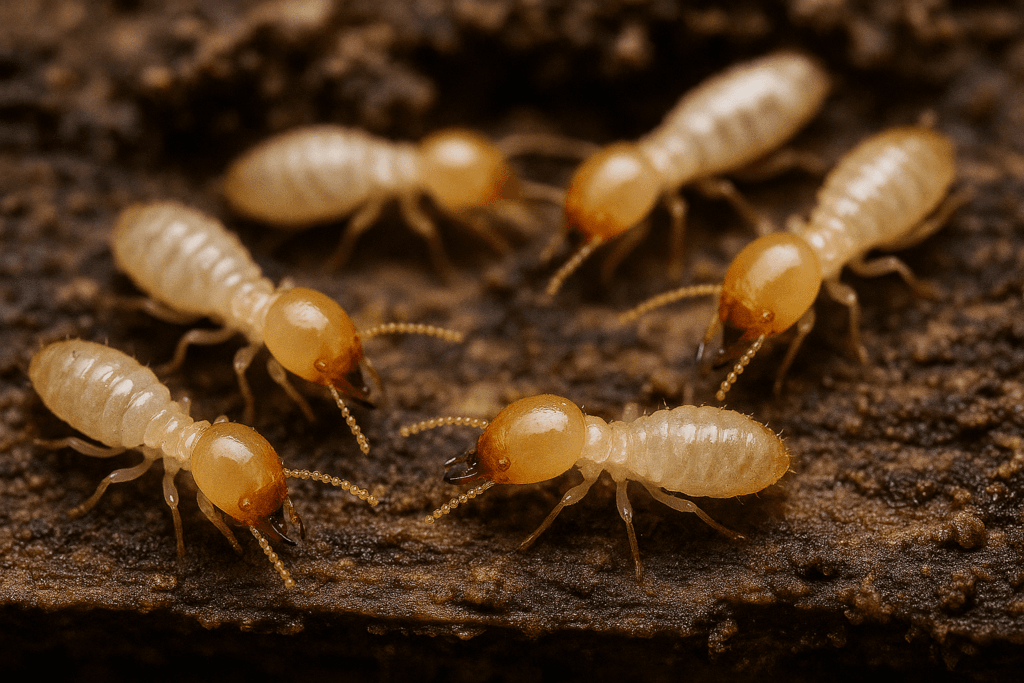
The three most reliable distinguishing features are the waist, the wings, and the antennae. Flying termites have a broad, uniform body with no pinch at the waist, four wings of equal length, and straight beaded antennae. Flying ants have a distinctly narrow, pinched waist, front wings that are noticeably longer than the rear wings, and elbowed antennae with a sharp bend.
The wing-shedding behaviour is also diagnostic: termite alates shed their wings very shortly after landing, leaving characteristic pairs of equal-length wings behind. Flying ants retain their wings after landing.
Bugs That Look Like Flying Termites
Several other insects are commonly mistaken for flying termites in Australia. Flying ants are the most common confusion. Others include whiteflies (much smaller, white-winged), winged aphids (smaller, softer body), and some species of flying beetles or psocids. If you’re uncertain, capture a few specimens in a sealed bag and photograph them against a white background — a pest controller can identify them from a clear photo.
What Do Flying Termites Look Like in Australia?
Australian termite alates are typically 8–15 mm in length including wings, pale to mid-brown in colour, with a soft, uniform body. The two most common swarming species in Sydney are Coptotermes acinaciformis (the most destructive termite in Australia) and Nasutitermes walkeri. Both produce pale brown swarmers with equal-length wings. Black flying termites are less common but do occur — darker colouring is typical of some Schedorhinotermes species found in coastal Sydney.
What Does a Termite Swarm Mean for Your Home?
Swarmers Inside the House: What It Means
Finding flying termites inside the house — emerging from walls, skirting boards, ceiling voids, or around window frames — is the more serious scenario. It means the parent colony is already inside your structure, or at minimum immediately adjacent to it. Alates emerging indoors almost always originate from a nest within the building envelope. This is not a situation that improves on its own. A professional termite inspection should be booked within 24–48 hours.
Swarmers Outside the House: Lower Risk, Still Act
Swarmers seen only outside — in the garden, around outdoor lights, or emerging from a tree stump or garden bed — indicate a colony in the yard or nearby soil. This is less immediately alarming than an indoor swarm, but still warrants action. The parent colony may be in a tree, a fence post, or underground — and it may already have extended its foraging tunnels toward your home’s timber. An inspection will determine whether activity has reached the structure.
Do Flying Termites Eat Wood?
No — termite alates do not eat wood. They are reproductives focused entirely on mating and colony establishment. They do not feed during the swarm period. The wood damage associated with termites is caused entirely by the worker caste, which remains hidden underground or inside timber and never swarms. This is an important distinction: the swarmers you see are not the problem themselves — they are the signal that the real problem (the worker colony) exists nearby.
What to Do If You See a Termite Swarm
Don’t Panic — But Don’t Ignore It
A termite swarm is alarming to witness, but the swarm itself causes no damage. The alates will die within hours if they don’t find suitable soil to establish a new colony. Your immediate concern is not the swarm — it is what the swarm tells you about the colony behind it. Stay calm, note where the swarmers are emerging from, and collect a few specimens if possible for identification. Photograph the emergence point.
What NOT to Do
Avoid these responses — they waste time or make things worse:
- Spraying the swarmers with insecticide. Killing the alates has zero effect on the parent colony. It addresses the symptom, not the cause, and gives a false sense of having dealt with the problem.
- Assuming it was just flying ants and doing nothing. The distinction matters. If you’re not certain which insect you saw, collect a specimen or photograph it and get it confirmed before deciding how to respond.
- Waiting weeks before booking an inspection. The parent colony is active right now. Every week of delay is another week of potential structural damage. Inspections are straightforward — there is no good reason to postpone.
DIY-treating the emergence point only. Applying spray or dust to the entry point termites were using addresses a tiny fraction of a colony that may number in the millions. Professional treatment targets the colony itself, not just the surface signs.
Book a Termite Inspection Immediately
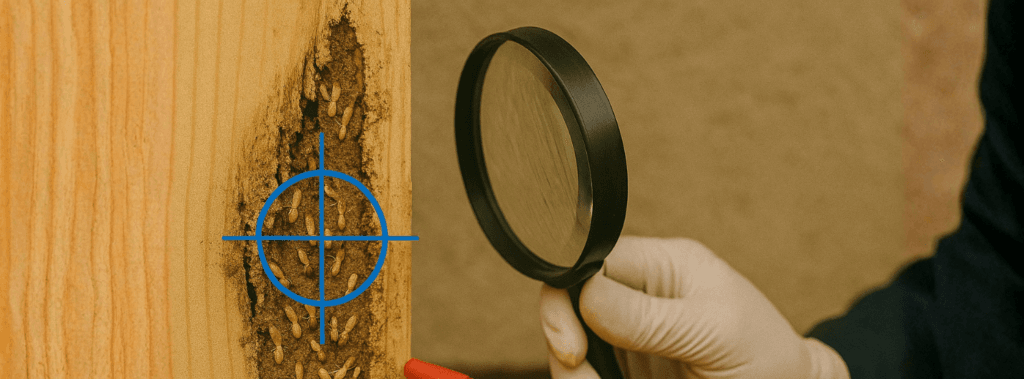
The correct response to a termite swarm — indoors or outdoors near the structure — is a professional termite inspection as soon as possible. A licensed inspector will use moisture metres, thermal imaging, and physical probing to locate active termite workings, identify the species, and assess the extent of any damage. This gives you a clear picture of what you’re dealing with before any termite treatment decisions are made.
What Happens After the Swarm?
Wings Left Behind: What They Tell You
The morning after a swarm, the most visible evidence is piles of discarded wings — typically on windowsills, along door frames, on outdoor tables, and near light sources. Each pair of equal-length wings represents one termite alate that landed, shed its wings, and either died or attempted to pair up and burrow. A large quantity of shed wings in a specific area — particularly near the base of a wall, a door frame, or a window — points toward the emergence location and should be photographed and reported to your inspector.
New Colonies Starting Near Your Home
Of the thousands of alates that leave a colony during a swarm, only a tiny fraction successfully establish new colonies. The founding pair must find suitable moist soil, excavate a chamber, and survive long enough to begin laying eggs — a challenging process with high failure rates. However, Sydney’s garden suburbs provide ideal founding conditions: soil moisture, timber debris, tree roots, and proximity to timber-framed structures. A swarm near your property is, statistically, also a seeding event for the next generation of colonies in your immediate area.
The Link Between Swarms and Active Infestations
There is a direct relationship between swarming and active structural infestations. Coptotermes acinaciformis — the species responsible for the majority of serious structural termite damage in Sydney — swarms from established colonies that have typically been active for at least three to five years. If a swarming termite event originates from inside or immediately adjacent to your home, the probability of an active infestation in the structure is high. This is not the time for watchful waiting.
How to Prevent Termite Swarms Reaching Your Home
Remove Attractants from the Garden
Termite colonies thrive on cellulose. Reduce what’s available around your home’s perimeter:
- Remove dead tree stumps — a classic termite founding and foraging site
- Keep timber off the ground: stack firewood on a raised rack, away from the house
- Remove old fence posts, railway sleepers used as garden edging, and buried timber debris
- Avoid using timber mulch directly against the foundation — use pebble or gravel instead
Reduce Moisture Around the Property
Termites need moisture as much as timber. Fix leaking garden taps, ensure subfloor ventilation is adequate, redirect downpipes away from the foundation, and address any drainage issues that cause water to pool near the house. A dry, well-ventilated subfloor is one of the most effective passive termite deterrents available to a Sydney homeowner.
Annual Termite Inspections: The Only Reliable Defence
No amount of garden management eliminates the risk of termites in Sydney — the city’s climate and housing stock make it one of the highest-risk termite environments in Australia. The only reliable defence is annual professional inspection. AS 3660.2 — the Australian Standard for termite management in existing buildings — recommends inspections at least every 12 months, and more frequently for high-risk properties.
An annual pest inspection gives you documented evidence of the current termite status of your property, detects activity before it reaches structural timber, and gives you the information needed to act before repairs become serious. The cost of an annual inspection is a fraction of what structural termite damage costs to fix.
Frequently Asked Questions
What does a termite swarm mean?
A termite swarm means a mature termite colony — at least three to five years old — is present nearby and is large enough to produce reproductive alates. The swarmers themselves don’t cause damage, but they are direct evidence of an active parent colony. If the swarm originates from inside your home or from the immediate perimeter, a professional inspection should be booked within 24–48 hours.
How do I know if I have flying termites or flying ants?
Check three features: the waist (termites have none; ants have a distinct pinch), the wings (termites have four equal-length wings; ants have longer front wings), and the antennae (termites are straight and beaded; ants are elbowed). Termites also shed their wings very quickly after landing, leaving piles of equal-length wings behind. If you’re unsure, collect a specimen in a sealed bag and photograph it.
Should I be worried if I see flying termites outside?
It depends on where they’re emerging from. Swarmers coming from a garden tree stump or soil away from the house are lower risk, but still worth having inspected. Swarmers emerging from near your foundations, from garden beds adjacent to the house, or from any point on the structure itself are a higher-priority concern and warrant an urgent inspection.
How long does a termite swarm last?
The active swarm — the cloud of flying insects — typically lasts 30 to 60 minutes, occasionally a few hours. The discarded wings and dead alates left behind may remain visible for a day or two. The swarm event is brief, but what it signals about the parent colony is not.
What should I do after a termite swarm?
Note where the swarmers emerged from, photograph the location and any discarded wings, collect a specimen if possible, and book a professional termite inspection as soon as possible. Do not spray the area with insecticide — it has no effect on the colony and may complicate the inspection. Do not wait to see if it happens again before acting.