

You open the wardrobe, pull out a favourite wool jumper, and find small irregular holes along the seams. Or you notice the edge of the carpet near the skirting board is starting to look thin and frayed in a way that doesn’t make sense for its age. You search for answers and land on bed bugs, moths, and a dozen other possibilities.
The actual culprit is often carpet beetles — one of the most underdiagnosed household pests in Australia. The adult beetles are small and rarely noticed. The damage is slow and easy to attribute to wear. By the time most homeowners realise they have a carpet beetle infestation, the larvae have been feeding through natural-fibre items for months.
This guide covers how to identify carpet beetles in Australia, what the damage looks like, how to get rid of them step by step, and when to call a professional. If you’re already dealing with an active infestation, our residential pest control team can assess and treat your home across Sydney.
What Are Carpet Beetles?
Types of Carpet Beetles in Australia
Several carpet beetle species are found in Australian homes. The most common are:
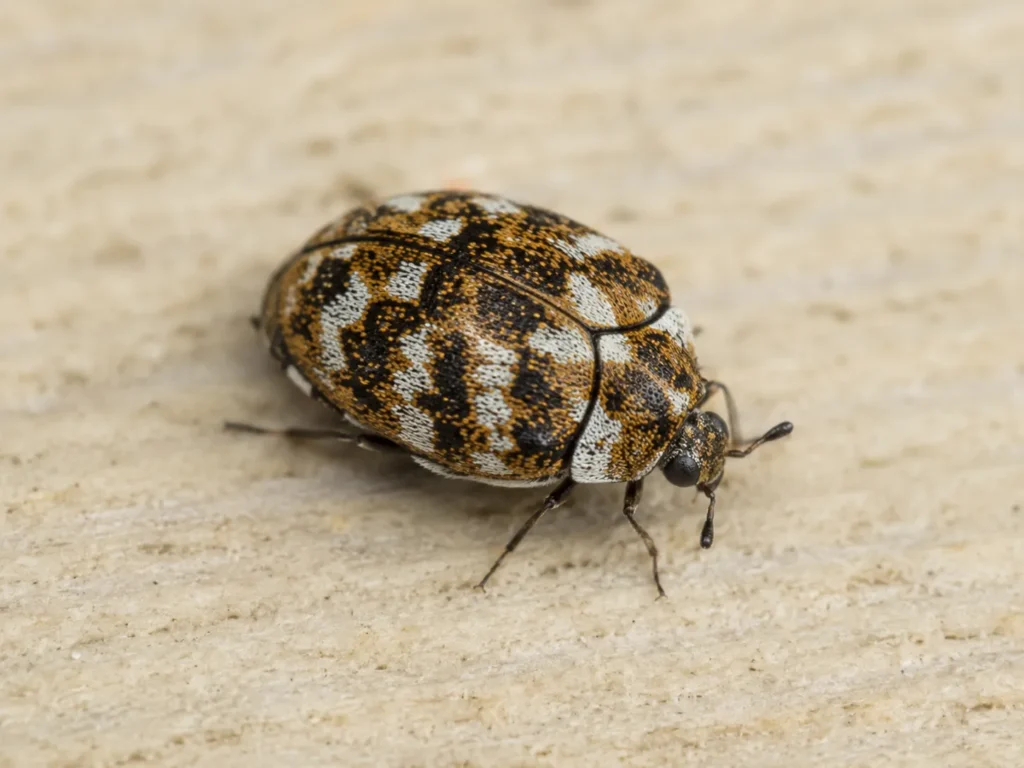
- Varied carpet beetle (Anthrenus verbasci): small (2–3 mm), mottled white, brown and yellow scales — resembles a tiny ladybird. The most widespread species in Sydney homes.
- Black carpet beetle (Attagenus unicolor): slightly larger (3–5 mm), uniformly dark brown to black. Common in roof voids where bird nests provide a food source.
- Furniture carpet beetle (Anthrenus flavipes): similar in size and appearance to the varied carpet beetle, with more cream and black patterning. Particularly damaging to upholstered furniture and stored woolens.
What Do Carpet Beetles Look Like?
Adult carpet beetles are small, rounded, and slow-moving. They are most often found near windows and on flowers, as they feed on pollen as adults — the larvae are the destructive stage. Carpet beetle larvae are 4–7 mm long, carrot-shaped, and covered in tufts of stiff brown or banded hairs. They are the ones causing damage and are found in dark, undisturbed areas: under furniture, in the folds of stored clothing, along carpet edges, and inside roof voids.
Carpet Beetle Larvae: The Real Problem
Adult carpet beetles are harmless. Carpet beetle larvae are the stage that causes all the damage — and all the skin reactions. They feed exclusively on keratin, the protein found in natural animal fibres: wool, silk, leather, feathers, fur, and dried animal products. Synthetic fibres are completely unaffected. A larva can take anywhere from two months to two years to complete its development depending on temperature and food availability, which is why a single infestation can cause ongoing damage over a long period if not treated.
Signs of a Carpet Beetle Infestation
Damage to Fabrics, Carpets and Clothing
Carpet beetle damage has a distinctive pattern: irregular bare patches or holes in natural-fibre materials, concentrated along seams, folds, and edges where larvae shelter from light. On carpets, look for thinning or bare patches near the skirting board, under furniture, and in the corners of rooms — areas that are rarely disturbed. On clothing, holes appear in wool, cashmere, silk, and feather-filled items. Synthetic fibres such as polyester and nylon show no damage — this is one of the clearest distinguishing features from general moth damage.
Shed Larval Skins
As carpet beetle larvae develop, they shed their skins (moult) multiple times. These shed skins — small, hollow, brown, bristly casings — are often the first visible sign of an infestation and are found in the same locations as the larvae: under furniture, in the back of wardrobes, along carpet edges, and in roof voids. Finding shed skins without seeing live larvae is still confirmation of an active or recent infestation.
Carpet Beetle Eggs: Where to Find Them
Carpet beetle eggs are tiny (less than 1 mm), white or cream-coloured, and laid in small clusters of 30–100 eggs directly on or near food sources. They are extremely difficult to spot without a magnifying glass. Common locations include the underside of rugs, inside wardrobes on or near wool items, in upholstered furniture seams, and inside bird nests in roof voids or wall cavities. Eggs hatch in 7–35 days depending on temperature.
Seeing Adult Beetles — Usually Near Windows
Adult carpet beetles are attracted to light and pollen. Finding small, slow-moving, mottled beetles on windowsills, on flowers in a vase, or around light fittings is a reliable sign that breeding is occurring somewhere in the property. Adults fly and can enter from outside on flowers, through open windows, or from bird nests in the roof. Seeing adults outdoors does not necessarily mean an indoor infestation — but finding them regularly indoors, or finding larvae and shed skins, confirms it.
Carpet Beetle Bites: Do They Bite Humans?
Carpet Beetle Rash vs Carpet Beetle Bites
Carpet beetles do not bite. The skin reactions associated with carpet beetles are caused by the stiff, barbed hairs (setae) covering the larval body — contact with these hairs triggers an irritant dermatitis in some people, producing an itchy rash, raised welts, or small red bumps. The reaction is often called a carpet beetle rash rather than a bite. It is most common on exposed skin — arms, neck, around the waistband — and tends to develop gradually over hours or days, rather than overnight like bed bug bites. Sensitivity varies significantly between individuals; some people show no reaction at all.
Carpet Beetle vs Bed Bug: Key Differences
This is the most common misdiagnosis in carpet beetle cases. The skin reactions can look similar, but several features clearly distinguish the two:
Carpet Beetle vs Bed Bug: Identification Guide
Carpet Beetle | Bed Bug | |
Skin reaction | Itchy rash or welts from larval hairs (not a true bite) | Red, itchy welts in clusters or lines — actual bites |
Reaction timing | Gradual — may take hours or days to appear | Immediate to overnight after sleeping |
Location on body | Exposed skin, arms, neck, around waistband | Any exposed skin while sleeping — face, neck, arms |
Insect visible | Rarely — larvae hide in fabric; adults near windows | Yes — adults visible in mattress seams, bed frame |
Damage to items | Holes in wool, silk, feathers, leather | No damage to fabric or items |
Blood spots | None | Small blood spots or dark faecal spots on sheets |
Where found | Carpets, wardrobes, under furniture, roof voids | Mattress seams, bed frame, skirting near bed |
The most reliable distinguishing factor: if you find fabric damage (holes in wool, bare patches in carpet) alongside the skin reaction, it is almost certainly carpet beetles. Bed bugs cause no damage to fabrics or clothing.
When to See a Doctor
Most carpet beetle rashes resolve without treatment once contact with infested items is avoided. Wash affected skin thoroughly with soap and water. If the rash is severe, widespread, or accompanied by swelling or difficulty breathing, seek medical attention — a small number of people develop a more significant allergic response to carpet beetle hairs. Antihistamines are the standard first-line treatment for the itch.
[IMAGE: Carpet beetle damage on a wool rug — irregular bare patches along edge and seam, next to intact synthetic carpet] Alt text: Carpet beetle damage Australia — irregular holes and bare patches in wool rug, carpet beetle infestation signs |
Where Do Carpet Beetles Come From?
How Carpet Beetles Get Into the House
Adult carpet beetles are outdoor insects that feed on pollen. They enter homes in several ways:
- Flying in through open windows or doors — particularly in spring and early summer when adults are active
- On cut flowers brought inside — a very common entry route, particularly with flowering garden plants
- In second-hand furniture, vintage clothing, or stored items that already contain eggs or larvae
- From bird nests in roof voids, wall cavities, or under eaves — nests contain feathers and dried matter that carpet beetles breed in readily
- On pet fur or dried pet food — carpet beetles are attracted to animal protein in any form
Where Carpet Beetles Hide
Carpet beetle larvae actively avoid light. They are found in the darkest, most undisturbed areas of the home:
- Under and behind large furniture that is rarely moved
- Along the edges of carpets, particularly near skirting boards
- Inside wardrobes — especially where wool, cashmere, or feather items are stored
- In roof voids and wall cavities with bird nests
- Inside upholstered furniture, particularly in the seams and beneath cushions
- In museum-type storage: taxidermy, dried flowers, feathered items, antique textiles
Carpet Beetle in the Bedroom: Why It Happens
Finding carpet beetles in the bedroom is common and typically explained by one or more of the following: wool or cashmere bedding, blankets, or clothing stored in or near the bedroom; a bird nest in the roof void directly above the room; feather-filled pillows or duvets providing a breeding site; or a wardrobe containing natural-fibre clothing that hasn’t been disturbed in months. The bedroom is also where carpet beetle rash is most often noticed — from contact with infested bedding or clothing overnight — which is why the bed bug misdiagnosis is so frequent.
How to Get Rid of Carpet Beetles
Effective carpet beetle treatment requires addressing all life stages — eggs, larvae, and adults — across all infested areas. Work through these steps in order:
Step 1: Identify and Remove Infested Items
Before treating, locate and remove all heavily infested items. Inspect every wool, silk, cashmere, leather, and feather item in the affected area. Items with active larvae or eggs should be sealed in a plastic bag immediately. Heavily infested items may need to be disposed of. Items that can be salvaged should be either dry cleaned (heat kills all life stages) or placed in a sealed bag in the freezer at -18°C for at least two weeks — cold kills eggs and larvae.
Step 2: Deep Vacuum — Every Surface
Thorough vacuuming is the single most important DIY step. Use a vacuum with a HEPA filter and vacuum every surface in the affected rooms: carpet (including edges and under furniture), upholstery (including seams and underneath cushions), inside wardrobes (shelves, walls, floor), skirting boards, and any other area where larvae or shed skins were found. Use the crevice tool along skirting boards and into carpet edges — this is where the highest larval concentrations are typically found. After vacuuming, seal and dispose of the vacuum bag or empty the canister into an outside bin immediately. Do not leave the contents inside the vacuum.
Step 3: Steam Clean Carpets and Upholstery
Steam cleaning at temperatures above 50°C kills carpet beetle eggs, larvae, and adults on contact. This is the most effective non-chemical treatment for carpets and upholstered furniture. Move slowly — at least 30 seconds per section — to ensure heat penetration. Pay particular attention to carpet edges, under furniture, and furniture seams. Steam cleaning after vacuuming (not instead of it) gives the best results, as vacuuming first removes the bulk of live insects and debris.
Step 4: Apply a Residual Insecticide Spray
For moderate to severe infestations, a residual carpet beetle spray applied to infested areas provides ongoing kill as larvae move through treated zones. Products containing bifenthrin, permethrin, or deltamethrin are effective. Apply along carpet edges, skirting boards, inside wardrobe bases, and beneath furniture. Allow surfaces to dry completely before allowing pets or children back into the area. Do not apply directly to items that will be in contact with skin — treat the surfaces around and beneath them instead.
Step 5: Treat Dark, Undisturbed Areas
Roof voids and wall cavities with bird nests are a frequently overlooked source of ongoing reinfestation. If you have birds nesting in the roof or under eaves, the nest material will continue to harbour carpet beetle populations that migrate down into the living space. Remove old, inactive bird nests from accessible roof void areas (wear a P2 respirator and gloves). Apply an insecticide dust (permethrin or bifenthrin dust) in the roof void along the ceiling joists where larval activity is suspected.
What NOT to Do
Avoid these mistakes — they waste time or allow the infestation to continue:
|
Natural Carpet Beetle Treatment Options
Diatomaceous Earth for Carpet Beetles
Food-grade diatomaceous earth (DE) applied as a fine dusting along carpet edges, inside wardrobes, and beneath furniture kills carpet beetle larvae through physical action — the microscopic particles damage their exoskeleton, causing dehydration. DE is non-toxic to humans and pets (avoid breathing the dust) and provides ongoing protection as long as it remains dry. It is particularly useful in wardrobes and storage areas where chemical sprays are not appropriate. Leave it in place for at least a week, then vacuum up.
Essential Oils as Repellents
Lavender, cedar, and clove oil have repellent properties against carpet beetles and are commonly used to protect stored clothing. Cedar blocks or lavender sachets in wardrobes and storage boxes deter adult beetles from laying eggs nearby. These are preventive measures, not treatments — they will not eliminate an existing infestation but are a useful addition to a prevention routine. Refresh cedar blocks by lightly sanding the surface every few months to restore the scent.
Boric Acid: Effective but Use with Care
Boric acid powder applied along carpet edges, beneath furniture, and in roof voids kills carpet beetle larvae as they walk through it. It is effective and long-lasting in dry environments. Keep away from areas accessible to pets and children — boric acid is toxic if ingested in significant quantities. Do not apply to surfaces that come into contact with food or skin.
How to Prevent Carpet Beetles Coming Back
Store Natural Fibre Items Correctly
Long-term storage of wool, cashmere, silk, and feather items is the highest-risk scenario for carpet beetle damage. Before storing, wash or dry clean all items thoroughly — larvae will not infest clean items as readily as soiled ones, as body oils and food residue attract them. Store in sealed, airtight containers or vacuum storage bags rather than open shelves, cardboard boxes, or fabric storage bags, which provide no protection. Add cedar blocks or lavender sachets to storage containers.
Vacuum Regularly — Including Under Furniture
The most effective prevention measure is consistent, thorough vacuuming — including along skirting boards, under furniture, and in the corners of rooms. These are the areas where carpet beetle eggs and larvae establish. A monthly deep vacuum of these areas significantly reduces the risk of an infestation developing. Pay particular attention in spring and early summer when adult beetles are active and most likely to enter and lay eggs.
Keep Windows Screened and Inspect Cut Flowers
Fit flyscreens to windows that are regularly opened in spring and summer to reduce adult beetle entry. Inspect cut flowers before bringing them inside — adult carpet beetles feed on pollen and are commonly transported into homes on garden flowers and supermarket bouquets. Shake or inspect flowers outdoors before bringing them in. Remove dead flowers promptly, as decaying flower material is attractive to beetles.
When to Call a Professional Carpet Beetle Pest Controller
Signs the Infestation Is Beyond DIY
DIY treatment is effective for a contained, early-stage carpet beetle infestation. Call a professional when: the infestation is spread across multiple rooms; damage is extensive and ongoing despite repeated treatment; you have a bird nest in the roof void that you cannot safely access; or you’re unsure whether you’re dealing with carpet beetles or another pest. A pest inspection will confirm the species, locate all infestation sites including hidden ones in the roof void, and give you a clear treatment plan.
What Professional Treatment Involves
Professional carpet beetle pest control typically involves a thorough inspection of all affected areas including roof voids and wall cavities; residual insecticide application to all infested and at-risk surfaces; dust treatment in roof voids where bird nests are present; and advice on preventing reinfestation. For heritage properties, museums, or commercial premises with natural-fibre collections, commercial pest control protocols include targeted treatment and ongoing monitoring to protect valuable items.
Frequently Asked Questions Do carpet beetles bite humans? No — carpet beetles do not bite. The skin reactions associated with carpet beetles are caused by contact with the stiff hairs (setae) on the larval body, which cause an irritant dermatitis in sensitive individuals. The resulting rash — itchy welts or red bumps — can look similar to insect bites but is not the result of the beetle feeding on skin. What kills carpet beetles instantly? Steam at temperatures above 50°C kills all life stages of carpet beetles on contact. Direct contact insecticide sprays (bifenthrin, permethrin) kill larvae and adults on contact. For eggs in fabric, dry cleaning or freezing at -18°C for two weeks is the most reliable method. There is no single product that addresses all life stages simultaneously — effective treatment requires a combination of physical and chemical methods. How long does it take to get rid of carpet beetles? A mild infestation treated thoroughly — including vacuuming, steam cleaning, and insecticide application — can be under control within 2–4 weeks. A moderate infestation typically requires 4–6 weeks of consistent treatment and monitoring. Severe or widespread infestations, or those with an active source in the roof void, may require professional treatment and can take 2–3 months to fully resolve. Can carpet beetles live in mattresses? Yes, if the mattress contains natural fibres such as wool or cotton filling, or if the mattress cover is a natural fabric. Synthetic foam mattresses with synthetic covers are not at risk. Finding shed larval skins or live larvae in or around the mattress — particularly in a mattress with a wool or cotton cover — confirms infestation. Encase the mattress in a sealed mattress protector and wash all bedding at 60°C. What is the difference between carpet beetles and bed bugs? The clearest distinguishing factors: carpet beetles damage natural-fibre fabrics (holes in wool, bare patches in carpet) while bed bugs cause no fabric damage. Bed bug bites appear overnight in clusters on exposed skin; carpet beetle rash develops gradually from contact with larval hairs. Bed bugs are visible in mattress seams and bed frames; carpet beetle larvae hide in dark areas under furniture and along carpet edges. If you find fabric damage alongside the skin reaction, it is almost certainly carpet beetles. |