
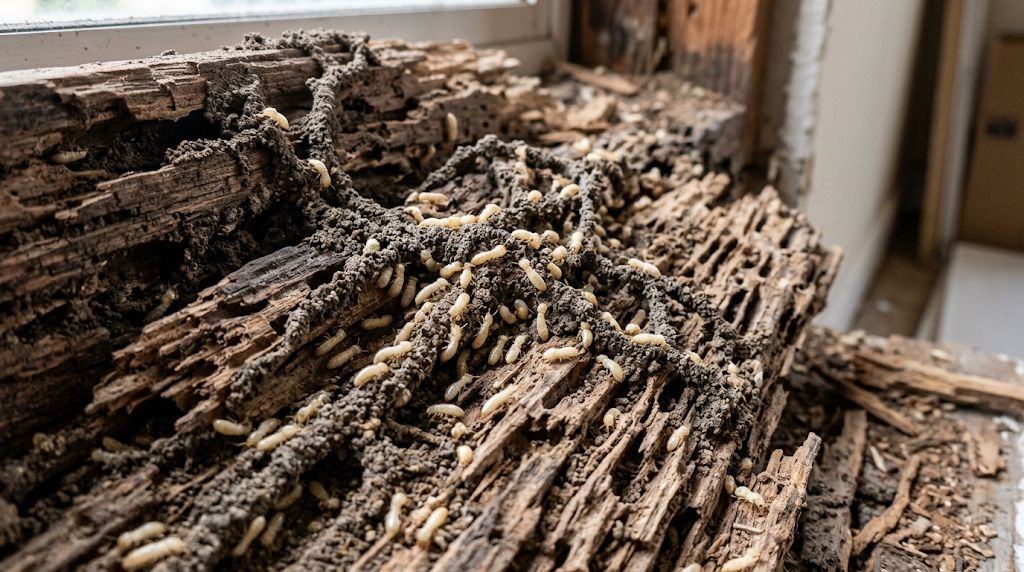
Most termites look like small, soft-bodied, creamy-white insects about 3 to 6 mm long, which is why they are often called “white ants”. Worker termites are pale and wingless, soldiers have a larger orange-brown head with strong jaws, and the flying termites (called alates) are darker with two pairs of equal-length wings. If you see any of these, or mud tubes and hollow-sounding timber, it is a strong sign of an active termite problem.
Termites cause more damage to Australian homes than fire, storms and floods combined, and most of it happens out of sight. Knowing what termites look like, and how to tell them apart from ants, is the first step to catching an infestation early. This guide walks through each termite type, the warning signs and what to do next.
What do termites look like up close?
A termite colony is made up of different “castes”, and each one looks different. Here is what you are most likely to find around a Sydney home:
- Workers are the most common. They are soft, creamy-white to translucent, 3 to 4 mm long, wingless and blind, and they do all the feeding and damage.
- Soldiers are a similar pale colour but have a distinctive larger, hardened orange-brown head with powerful pincer-like jaws used to defend the colony.
- Alates (flying termites) are the reproductives. They are darker, brown to black, around 8 to 12 mm including wings, with four wings of equal length that they shed after swarming.
- The queen is rarely seen, hidden deep in the nest, and can grow much larger than the rest as her abdomen swells with eggs.
Which termite is which? A quick identification guide
Use this table to match what you have seen to the termite caste and what it usually means.
| Termite type | What it looks like | Where you see it | What it means |
|---|---|---|---|
| Worker | Creamy-white, soft, 3 to 4 mm, no wings | Inside damaged timber, mud tubes | Active feeding colony nearby |
| Soldier | Pale body, large orange-brown head, big jaws | Exposed when you break open mud or timber | Established, defended colony |
| Alate (swarmer) | Dark brown to black, 8 to 12 mm, 4 equal wings | Around lights and windows at dusk, mainly spring and summer | A mature colony is spreading |
| Discarded wings | Small, equal-sized, see-through wings in piles | Windowsills, webs, floors near light | Swarmers have been inside recently |
What is the difference between flying termites and flying ants?
Flying termites and flying ants are easy to confuse, but three features tell them apart:
- Waist: termites have a straight, thick body with no waist; ants have a clearly pinched, narrow waist.
- Wings: a termite’s four wings are all the same length; an ant’s front wings are noticeably longer than the back pair.
- Antennae: termite antennae are straight and bead-like; ant antennae are bent, like an elbow.
If the insect has no waist and equal wings, treat it as a termite until proven otherwise.
What are the signs of termites in your home?
You will often notice the damage before you see a single termite. Check for these warning signs:
- Mud tubes: pencil-width tunnels of mud running up walls, piers, foundations or in the subfloor.
- Hollow or papery timber: skirting boards, door frames or floors that sound hollow when tapped.
- Discarded wings: small piles of equal-sized wings near windows and lights after a swarm.
- Frass: tiny pellets of timber-coloured droppings from drywood termites.
- Tight-fitting or jamming doors and windows, or bubbling, cracked paint.
- Soft, blistered or sagging floors, and visible galleries if timber is opened up.
What does termite damage look like?
Termites eat timber from the inside out, so a piece of skirting or a door frame can look almost normal on the surface while being hollowed out behind the paint. When you break it open you will often see a honeycomb of galleries packed with mud and moisture, and sometimes live workers and soldiers. Because the damage is hidden, a professional inspection with moisture and movement detection is the only reliable way to know the full extent.
What should you do if you think you have termites?
If you find termites or any of the signs above, the most important rule is do not disturb them and do not spray them. Breaking open tubes or spraying surface insecticide makes the colony retreat and spread to new areas, which makes treatment harder. Instead, leave everything as it is and book a professional. Wallace Pest Solutions provides professional termite treatment and can trace the colony and treat it at the source, and a thorough pest inspection will confirm how far the activity has spread.
According to CSIRO, several of Australia’s most destructive species (such as Coptotermes) can cause significant structural damage before they are detected, which is why the Australian Standard AS 3660 recommends a professional timber pest inspection at least once a year. Regular inspections are also the best way to protect your home as part of ongoing residential pest control, and spring is the ideal time to check, as covered in our guide to spring pest control.
Frequently asked questions about termites
Are termites the same as white ants?
Yes. “White ants” is a common Australian nickname for termites, but termites are not actually ants. They are soft-bodied, pale and more closely related to cockroaches, and they behave very differently to ants.
What do flying termites mean?
Flying termites, or alates, leave a mature nest to start new colonies, usually on warm, humid evenings in spring and summer. Seeing them in or around your home means a developed colony is nearby and actively spreading, so it is worth arranging an inspection promptly.
Can you see termites with the naked eye?
Yes, individual termites are visible, around 3 to 12 mm depending on the caste. The problem is that workers stay hidden inside timber and mud tubes, so you may have an active infestation without ever seeing one in the open.
What attracts termites to a house?
Termites are drawn to timber in contact with soil, moisture from leaks or poor drainage, stored wood and mulch against the house, and warm, humid conditions. Reducing moisture and keeping timber away from the ground makes a property far less attractive to them.
How quickly do termites cause damage?
A large, established colony can cause significant structural damage within months, though it often goes unnoticed for much longer because it happens inside the timber. Early detection through annual inspections is the best way to limit the cost and extent of any damage.